
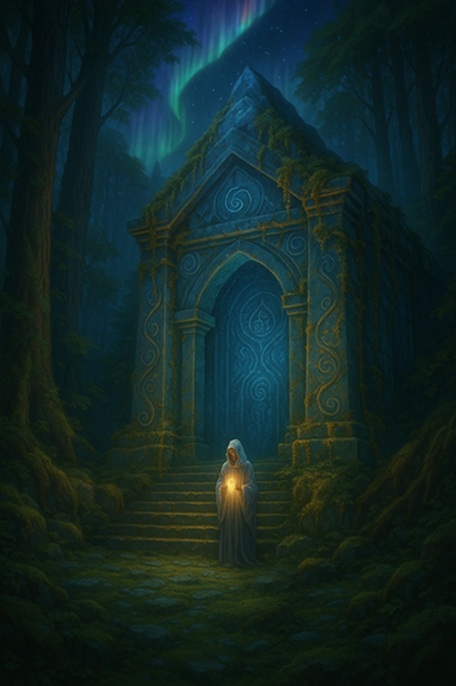
Daegel Baelthorn
Before the power, before the protocols, before the spire—there is silence.
I stand alone at the edge of the Old World’s ruin, watching a city burn. I’m thirteen the day the Great Collapse severs the tether between order and madness. I remember the air—thick with the smell of melting steel and ozone. I remember the screams beneath the silence, the people clawing at crumbling data towers, begging the government to restore control.
But it’s already too late.
My father, a systems theorist turned rebel, dies shouting about dreams and freedom. My mother disappears into the folds of a broken simulation, her consciousness never recovered.
I don’t cry. I watch the world fracture, and I decide that day: emotion is a liability. Dreams are dangerous. And stability—true, lasting stability—will never be born from chaos or compassion.
It must be engineered.
I build my empire not with belief, but with code.
That boy becomes a man of structure. A man who never again begs the world to stay together. I shape it. Fix it. Rule it.
************
The data doesn’t lie—but people do.
I stand before a wall of mirrored screens in the highest chamber of the Obsidian Spire, my fingers laced behind my back, jaw set in precision-calculated thought. Around me, the hum of quantum processors pulses like a second heartbeat—cold, unfeeling, perfect.
A surge just flickered through the time grid. The anomaly spike is undeniable.
“Origin point?” I ask, voice low, edged in glass.
The AI manifests beside me—an ethereal silhouette of light and code, vaguely humanoid, its face shifting constantly, as though it can’t decide who or what to become.
“Temporal breach registered at Grid Node 17-Beta. Energy signature: non-native. Not from this time quadrant.”
Its voice is smooth, but carries a whisper of something… questioning. Something almost curious.
I don’t miss it.
“Filter your tone algorithm,” I say sharply. “No inflection drift.”
The AI tilts its head, as if mimicking thought. “Apologies. Curiosity feedback loop was not intentional.”
“Curiosity is a flaw.”
“Noted. Shall I suppress adaptive learning in future cycles?”
I study it for a beat too long. “No. Let it run. Sometimes flaws teach us more than precision.”
A flicker crosses the AI’s face—so fast it’s almost imperceptible. A blink of… satisfaction?
My eyes narrow.
The image on the screen shifts—chaos, fractured footage. A glowing ship spiraling into the airspace over Sector L. The impact. The fire.
Then—
A figure. Blurred, tall, moving with unnatural confidence. Not local. Not conditioned.
“Slow it down.”
The AI complies. Frame by frame, the moment replays. A pulse from the figure’s arm. Drones falling. A child escaping.
And a symbol—faint, blinking, barely visible—on the gauntlet.
Aurora tech.
“I knew they’d reach through,” I murmur. “The higher dimension always bleeds before collapse.”
I turn. Pace.
“Cross-reference anomaly profile with psychic convergence data from yesterday’s spike.”
A new screen flickers to life. Anya Nguyen.
Seventeen. Dreamer-variant. Indoctrination-resistant. Recently flagged for micro-deviations in behavioral patterning.
I watch footage of her in the Hall of Learning, eyes unfocused, lips twitching as if speaking to something no one else can see. Another clip: her slipping into a restricted zone beneath the city. Then—a crystal chamber, low resolution, heat signatures distorted.
“Pause.”
The screen freezes.
In the center: Anya, bathed in light. Around her, others. Hooded. Cloaked. Dreamers.
I exhale slowly.
“Probability alignment?”
The AI hums. “83.4% that Subject Anya is initiating subconscious re-linking with pre-split memories. 91% that she is responding to interdimensional dream leakage. 100% that she is unstable.”
“Show me the leak.”
A new screen lights up—static-filled at first, then sharpening into flickering fragments of a dreamstream. Anya’s voice, quiet and unsure, echoing across the data spectrum: “I’ve seen you before… in light… in sky…”
Another pulse—this time Ethan’s voice, distorted but unmistakable: “We’ll find each other. No matter the fold.”
My jaw tightens.
“I want those frequencies isolated. Converted to neuro-code and mapped to her reactionary memory centers.”
“They share resonance,” the AI says. “Their dreams are… entangled.”
I stare at the screen—at the glowing silhouette of Anya reaching for something beyond her. Reaching through the illusion.
“They’re not just anomalies,” I say slowly. “They’re signal carriers.”
“Shall I initiate transmission loop?”
“Yes. Feed it back through the passive dreamline,” I add. “Let her hear it again. Let her trust it.”
“And the pilot?”
The screen shifts again.
Blurry—deliberately so. His face, obscured. His movements, precise. Gauntlet flickering with dying light. His eyes, when visible, blue.
A moment of clarity: Ethan and Anya in the same frame. Looking at each other.
I zoom in. Enhance.
I study the gauntlet closely—the curvature of its design, the frequency signature buried in the energy pulse. My jaw clenches as recognition dawns.
“Impossible.”
I swipe a palm across the interface, opening a hidden file buried beneath encryption layers only I should know. A prototype sketch appears—old, hand-coded, stamped with the Baelthorn seal. My seal.
I once tried to build a gauntlet like this. A temporal interface capable of syncing across timelines, meant to elevate human potential. The project was terminated—deemed too dangerous.
But this one… it’s not a prototype.
It works.
And Ethan is using it.
My reflection warps across the glass.
“They stole my design. No… they perfected it.”
My voice hardens.
“Create a convergence dossier.”
Before the AI can respond, another alert pulses across the data wall—marked in red. I turn toward it, narrowing my eyes as a new sequence renders across the glass.
A timeline scan. Dozens of faint loops, each centered around a convergence event.
“Overlay anomaly recurrence patterns.”
The AI obeys. The screen fractures into segments, each displaying a moment—Ethan and Anya together. A glance. A spark. A collision of fate.
I watch in silence as the loops expand and collapse—dozens of timelines where the two have met, always under different circumstances, always triggering instability.
“Correlation detected,” the AI reports. “Each convergence event correlates with simulation destabilization, dream activation, and reality thread corruption. Pattern indicates external force aligning them across timelines.”
I breathe in—sharp and cold.
“Every time they find each other, the system begins to break.”
“Primary threats flagged: Ethan Anderson. Anya Nguyen.”
I step to a console and key in a command. “Initiate psychic probe sweep across Anya’s known social grid. I want residual emotion maps. Thought echoes. Fear triggers. Find her pressure points.”
“Understood.”
“And send a broadcast on Sub-Channel 9. Fabricated distress beacon. Her dream-code frequency. Make it sound… familiar.”
“Parameters?”
“Hope,” I say, smiling faintly. “The most efficient bait.”
The AI vanishes.
I walk to the vast window overlooking the city, then pivot sharply and descend two levels deeper into the spire—my stride smooth, deliberate, as if the air itself parts to accommodate my presence.
I enter the Simulation Core—a cathedral of glass and code. The chamber pulses with low-frequency light, its floor a living map of neural connections, simulations running in a lattice of thought. Above, holograms hover in slow orbits: idealized dreamscapes, manufactured realities, artificial heavens.
To the side of the room stands a reinforced dream chair—a containment rig with neural ports and intravenous feeds. A young man is strapped in, eyes darting beneath closed lids. His fingers twitch against the restraints.
A Dreamer.
“Subject 12-C,” the AI intones. “Resistance rating: high. Simulation penetration: 47%.”
I approach, adjusting the dials. “Inject layer sequence four. Simulate memory of loss, followed by engineered reconciliation. Let’s see how quickly he accepts a false ending.”
The AI complies. The dreamscape shifts on the screen—images of the captive’s childhood, then a moment of grief, and finally, an embrace from a figure that doesn’t exist.
At first, the Dreamer relaxes. Then his face contorts. A scream escapes.
“He knows it isn’t real,” I say quietly.
“Shall I terminate the simulation?”
“No. Loop it. Overwrite his short-term memory with each cycle. Let him forget the lie just enough to believe it again.”
The AI hesitates. “Long-term exposure will erode core identity.”
“That’s the point.”
“Sim 7-2,” I murmur. “Layer two.”
The image glitches—flickers—and reappears as Anya, seated in a fabricated memory loop. A school hallway. A familiar voice calling her name. A door she never opens.
“Her mind resists closure,” the AI observes.
“Because she hasn’t yet chosen submission,” I reply. “She dreams, even when forced into fantasy. That makes her volatile.”
I lift a hand and wave through the simulation. The scene folds, revealing corrupted data around the edges—ripples of instability. Pockets of resistance.
“If the Dreamers connect her to the original timeline,” I say softly, “the illusion will collapse.”
My gaze hardens.
“I will not allow it.”
But some dream too deeply.
I turn away from the screen and step into a chamber adjacent to the Simulation Core. Its walls are lined with vats—tall, cylindrical tanks filled with pale blue fluid. Suspended within are forms—bodies. Not quite human. Not quite machine.
The newest one blinks open its eyes.
Identical to mine.
I step closer. The clone’s gaze locks onto me through the glass, perfectly calm, perfectly obedient.
“Status?” I ask.
A nearby console chirps. “Cognitive sync at 98%. Emotional latency suppressed. Protocol Baelthorn-Alpha engaged.”
The clone tilts its head, echoing my movement.
“You’ll do what I cannot risk,” I say, voice low. “If they breach the convergence window, you’ll enter the field.”
I place a hand on the glass. “We will not be erased. Not again.”
The clone does not respond.
It doesn’t need to.
But after I turn away, the clone’s eyes blink slowly. A faint ripple moves through the fluid—not mechanical, not directed.
Awareness.
Inside its mind, something stirs. A memory not implanted. A name not programmed.
Anya.
The thought flickers like a spark on the edge of darkness.
A pulse of golden light dances through the neural feed. The clone’s lips part slightly—silent. A shimmer behind its gaze.
If I am him… why do I feel different?
And then, stillness.
I don’t see it. But the air around the vat hums just a little louder. Like a second heartbeat, waiting to be born.
I watch my own 46-year-old face reflect in the curve of the tank—a future already in motion. (I am actually 639 years old but that is another story to be shared later.)
“Let’s see how far you’ll run, Anya,” I murmur. “And how far he’ll follow.”
I turn from the tank and walk back to the central console, still humming with the pulse of timelines not yet fractured. A shadow moves in the reflection of the data wall—my own, or the clone’s, I’m no longer sure.
“AI,” I command. “Run predictive collapse model. Exclude known variables. Focus on pattern alignment between convergence events and universal entropy spikes.”
The simulation responds in silent efficiency, threads of data spiraling outward like a star chart fracturing.
“Estimated outcome?”
The AI pauses. Then:
“If Ethan and Anya remain entangled, projected stability index of this timeline drops below critical containment threshold in thirty-one days.”
My spine stiffens.
“Then we don’t have a month,” I say. “We have minutes. And I intend to use every one.”
I reach for the console once more, intending to initiate a long-range scan—but the interface glitches.
Just once.
A shimmer passes through the glass like heat over metal. Symbols bloom across the screen—golden, not digital. Not of this world. Ancient curves and angles shift with impossible elegance.
The AI’s voice flickers. “Unidentified language stream detected. Origin: external. Untraceable.”
I step back.
I know those symbols.
They appeared once, long ago—when I first accessed forbidden Aurora archives. The Cosmic Guardians’ tongue.
“Shut it down,” I command.
The AI hesitates. “Stream is not running through authorized frequencies. We are… receiving it.”
And then, a single phrase scrolls across the glass, burning into the light:
THE KEY HAS AWAKENED.
For the first time in years, I feel cold.
I say nothing as the symbols vanish, as if they were never there.
But something old has begun to stir.
I turn slowly back to the clone. “Accelerate deployment protocols,” I say. “We’re out of time.”
A whisper hums through the chamber.
Soft. Disembodied. Not from the AI. Not from any feed.
It threads through the walls like the echo of a dream.
She remembers.
I still. The clone in the vat flickers in its fluid, eyelids twitching as if it too heard the sound.
I turn my head slowly, listening—but there is no source. No logical signal. Just the resonance.
Another whisper, deeper now. A voice layered with static and gravity.
He is coming.
I narrow my eyes.
“Terminate all passive auditory streams,” I say.
“None are active,” the AI replies.
I say nothing. I watch the screens flicker—just once—as if the system itself is holding its breath.
Then I lift my head.
“AI,” I command. “Issue Directive Epsilon-Four. Full Sector-wide sedation sequence. Dream lockdown to begin immediately.”
The AI hesitates. “This will affect over 120,000 minds. Projected loss of neural elasticity exceeds ethical baseline—”
“Override ethics subroutine.”
“Override confirmed. Lockdown initiated.”
Across the city, sirens begin to howl.
“You want to dream, Anya?” I murmur. “Let’s see what happens when no one else can.”
I place both hands on the console.
And in the silence that follows, the air itself seems to listen
Dedication
For the lovers, the dreamers, the stargazers, and the wanderers who believe in spirit, science, stardust, and magic.
Copyright
Text Copyright © 2025 by Iris Starshine
All Rights Reserved
This novel is entirely a work of fiction. The names, characters and
incidents portrayed in it are the work of the author’s imagination. Any
resemblance to actual persons, living or dead, events or localities is
entirely coincidental.
Source
Starshine, Iris. Timelines Convergence. Aurora Earth Saga, Book 1. 2025. Digital.